
Table of Contents
▸ 1. What Is a Lab Booking and Report Delivery Platform?
▸ 2. How Does the Booking and Home-Collection Flow Work?
▸ 3. How Do You Track a Sample From Accession to Result?
▸ 4. How Does LIS Integration and Report Delivery Actually Work?
▸ 5. Which Features Must the Platform Have for Patients and Labs?
▸ 6. What Tech Stack and Cost Should You Plan For?
▸ 7. The Lab Platform Build Readiness Checklist
▸ 8. Frequently Asked Questions
Why do diagnostic labs lose patients even when their testing quality is strong? Most drop-offs happen not in testing accuracy, but in two weak points: manual phone-based booking and delayed report delivery. Acquaint Softtech helps diagnostic labs build digital platforms that streamline booking, tracking, and instant report delivery.
This guide explains how modern lab systems reduce customer-service load, enable real-time sample tracking, and deliver reports directly to patients’ devices for a seamless experience.
As a project manager at Acquaint Softtech, I build platforms that connect online booking, home collection, sample tracking, and secure report delivery into one continuous flow. Our MERN stack development team builds diagnostic lab platforms for labs and diagnostic chains across the USA, UK, and Europe.
This is a platform guide in the lab and diagnostics cluster. For the lab system that processes the samples this platform books, the Laboratory Information System Development guide covers the LIS this platform integrates with. For a broader understanding of healthcare platforms, refer to The Complete Guide to Healthcare Software Development in 2026: Types, Costs, Compliance, and How to Build.
1. What Is a Lab Booking and Report Delivery Platform?
A lab booking and report delivery platform is the patient-facing and operational layer that sits on top of a laboratory information system (LIS). It handles test discovery and booking, home or walk-in sample collection, sample tracking, payment, and secure delivery of validated reports to patients and physicians. The LIS runs the testing; the platform runs the experience around it.
Platform versus LIS
The LIS is the lab’s internal engine: sample accession, instrument integration, result validation, and signing. The platform is everything the patient and referring physician touch: booking, tracking, payment, and report access. A complete diagnostic offering needs both, connected by a clean integration layer.
The build decision is usually whether to add a platform on top of an existing LIS or build both together. Acquaint Softtech’s software product development practice scopes that boundary first, so the platform and LIS responsibilities are cleanly separated rather than tangled.
The platform serves several audiences at once: patients, phlebotomists, lab staff, and referring physicians. Our Laravel developers build the multi-role backend and portals that give each audience the right view of the same journey.
See also: Understanding the Smart Use of Loyalty Rewards
2. How Does the Booking and Home-Collection Flow Work?
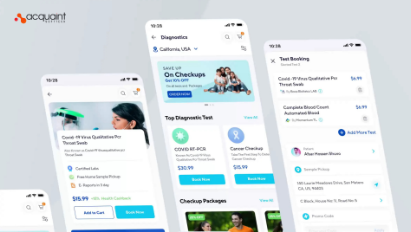
The booking flow lets a patient discover tests, see transparent pricing, choose home collection or a walk-in slot, and pay, all online. For home collection, the platform schedules a phlebotomist, optimises their route, and tracks the visit in real time. Auto-scheduling and integrated billing remove the phone calls and manual coordination that slow traditional labs.
The booking and collection essentials
1. Test catalogue with clear descriptions, preparation instructions, and transparent pricing.
2. Slot booking for walk-in centres and time-window scheduling for home collection.
3. Phlebotomist assignment and route optimisation for home visits.
4. Integrated payment with cash, insurance, and corporate price lists.
5. Real-time status from booking confirmed to phlebotomist en route to sample collected.
Home collection is the differentiator for modern labs, and it is a logistics problem as much as a booking one. A dedicated software development team builds the scheduling, routing, and phlebotomist-app pieces that make home collection reliable rather than chaotic.
Patients and phlebotomists both live on mobile, so the booking and collection apps must be first-class on a phone. Our React Native developers build the patient booking app and the phlebotomist collection app on a shared cross-platform codebase.
Sample tracking follows a defined lifecycle, and the platform’s job is to keep that status live for everyone who needs it. A sample moves from collected, to in-transit, to accessioned, to in-testing, to validated, to reported. Each transition updates the patient’s tracker and the lab’s worklist automatically, which is what ends the endless where-is-my-result phone calls.
For teams building such systems, scalable backend and frontend engineering support like Hire MEAN Stack Developers is often used to implement real-time tracking and workflow automation effectively.
Modelling this as an explicit lifecycle with barcode-driven transitions is what makes tracking reliable end to end. Our Python developers build the tracking engine and the barcode and accession logic that keep sample status accurate at every step.
The tracking and LIS handoff need to stay correct as lab workflows and instruments change. Keeping that accurate over time is exactly what ongoing support and maintenance services handle, so the tracker never drifts from reality.
4. How Does LIS Integration and Report Delivery Actually Work?
LIS integration is the core engineering challenge. Labs speak HL7 v2 (ORU result and ORM order messages) on older systems and FHIR on newer ones. The proven approach is a dedicated integration gateway that maps every feed into one canonical internal model, with validation pipelines and dead-letter handling so one bad message never blocks the result feed.
| Integration Element | What It Handles | Why It Matters |
| Integration gateway | Isolates LIS quirks from your stack | One bad feed cannot break the platform |
| Canonical data model | One internal shape for orders and results | Each HL7 or FHIR feed is just an adapter |
| HL7 v2 (ORU / ORM) | Results and orders from legacy LIS | Most installed labs still use it |
| FHIR resources | DiagnosticReport, Observation, ServiceRequest | Newer stacks and interoperability |
| Queues and dead-letter | Reliable message handling | No silent data loss on a bad message |
Report delivery itself must be secure and multi-channel: a patient portal, a physician portal, and notifications when a report is ready, replacing manual dispatch entirely. Acquaint Softtech’s AI and ML development services can add plain-language report explanations and trend highlighting as clinician-supervised decision support, never autonomous diagnosis.
The integration gateway is long-term healthcare API work, not a one-off connector, so it needs to be engineered for resilience. Our Django developers build the HL7 and FHIR integration gateway, mapping pipelines, and secure report-delivery services. For the FHIR resources that carry diagnostic results, the FHIR API Integration Guide shows how DiagnosticReport and Observation data flows between systems.
5. Which Features Must the Platform Have for Patients and Labs?
The platform needs two coordinated feature sets. Patients need online booking, home collection, payment, a live sample tracker, secure report access, and health-trend history. Labs need a provider portal, worklists, automated report dispatch, multi-rate billing (cash, insurance, corporate), and analytics. A white-labelled patient portal and a physician portal are now expected, not optional, and this is often delivered through white-label software development solutions.
| Audience | Must-Have Features | Outcome |
| Patient | Booking, home collection, tracker, reports, trends | Self-service, fewer support calls |
| Physician | Provider portal, electronic report delivery | Faster diagnosis, repeat referrals |
| Lab staff | Worklists, accession, validation, dispatch | Automated workflow, less manual work |
The strategic feature is the white-labelled patient portal, because it turns a one-time test into an ongoing health relationship with trends and easy re-booking. A virtual CTO service helps you decide which features belong in the first release versus later, so the platform launches without over-building.
Serving patients, physicians, and lab staff reliably at scale is an infrastructure problem as much as a feature one. Our DevOps engineers build the scalable, encrypted, audit-logged infrastructure that keeps every portal fast and compliant.
6. What Tech Stack and Cost Should You Plan For?
The proven 2026 stack is React for the web portals, React Native for the client and phlebotomist apps, Node.js or Python for the backend, PostgreSQL for data, and a dedicated HL7 and FHIR integration gateway.
A custom booking-and-delivery platform costs $70,000 to $250,000 over 5 to 10 months, while a full custom LIS underneath can reach $100,000 to $800,000 or more (SCN Soft LIS guide).
| Scope | Cost | Equivalent |
| Booking, collection, tracking, report delivery (on existing LIS) | $70,000 to $250,000 | GBP 56K to 200K / EUR 64K to 230K |
| Add full custom LIS underneath | $100,000 to $800,000+ | GBP 80K to 640K+ / EUR 92K to 736K+ |
| Each extra integration (EHR, payment, courier) | $5,000 to $30,000 | GBP 4K to 24K / EUR 4.6K to 28K |
The biggest cost driver is whether you integrate with an existing LIS or build one, followed by the number of integrations. Offshore delivery lowers the build cost without lowering the standard, and software development outsourcing delivers lab platforms at $25 to $49 per hour, roughly 40 percent below US agency rates.
A platform with this many moving parts benefits from flexing specialists for the integration and mobile phases. For that, staff augmentation adds HL7 or FHIR and mobile engineers for the phases that need them, then scales back.
7. The Lab Platform Build Readiness Checklist
Run this before committing to a lab platform build. Every unchecked box is a broken handoff between booking, lab, and patient. This is the checklist Acquaint Softtech applies before a lab platform build begins.
☐ Test catalogue with prep instructions and transparent multi-rate pricing
☐ Booking for walk-in slots and home-collection time windows
☐ Phlebotomist assignment, route optimisation, and a collection app
☐ Sample lifecycle tracked from collected to reported with barcodes
☐ Integration gateway with a canonical model for HL7 v2 and FHIR
☐ Queues and dead-letter handling so one bad message never blocks results
☐ Pathologist validation and signing gate before any report is released
☐ Secure report delivery to patient and physician portals with notifications
☐ Multi-rate billing: cash, insurance, and corporate price lists
☐ HIPAA safeguards throughout: encryption, access control, audit logging
Treat the validation-and-signing gate as non-negotiable: no result reaches a patient before a pathologist signs it. Locking the journey, integrations, and gates up front in a structured discovery workshop prevents the expensive rework that comes from discovering a broken handoff late.
A lab platform coordinates patient apps, phlebotomist logistics, LIS integration, and physician portals at once. Our project managers run the rollout so each piece ships in the right order without breaking the live testing flow.
8. Frequently Asked Questions
How much does it cost to build a diagnostic lab booking and report delivery platform?
| Platform Type | Cost Range | Timeline |
| LIS-based diagnostic lab platform | $70,000 – $250,000 | 5 – 10 months |
| Full custom LIS system | $100,000 – $800,000+ | 6 – 18+ months |
| Third-party integrations (per integration) | $5,000 – $30,000 | Depends on scope |
What features does a lab booking and report delivery platform need?
Patients need booking, home sample collection, secure payments, real-time tracking, and digital reports. Labs need a dashboard, automated worklists, dispatch management, and billing tools. HL7 and FHIR integration ensures secure data exchange and report validation.
How long does lab platform development take?
An LIS-based platform usually takes 5 to 10 months to build. A full custom LIS can take 6 to 18 months or longer. Integration, tracking, and compliance workflows take the most development time.
What tech stack is best for a lab booking platform?
React is used for web portals and React Native for mobile apps. Node.js or Python powers the backend with PostgreSQL for data storage. HL7 and FHIR layers are essential for LIS connectivity.
How does LIS integration work in a lab platform?
LIS integration uses a middleware gateway that converts HL7 v2 and FHIR data into a unified internal format. It manages data flow using queues, retries, and error handling. This ensures continuous, reliable integration rather than a one-time setup.
